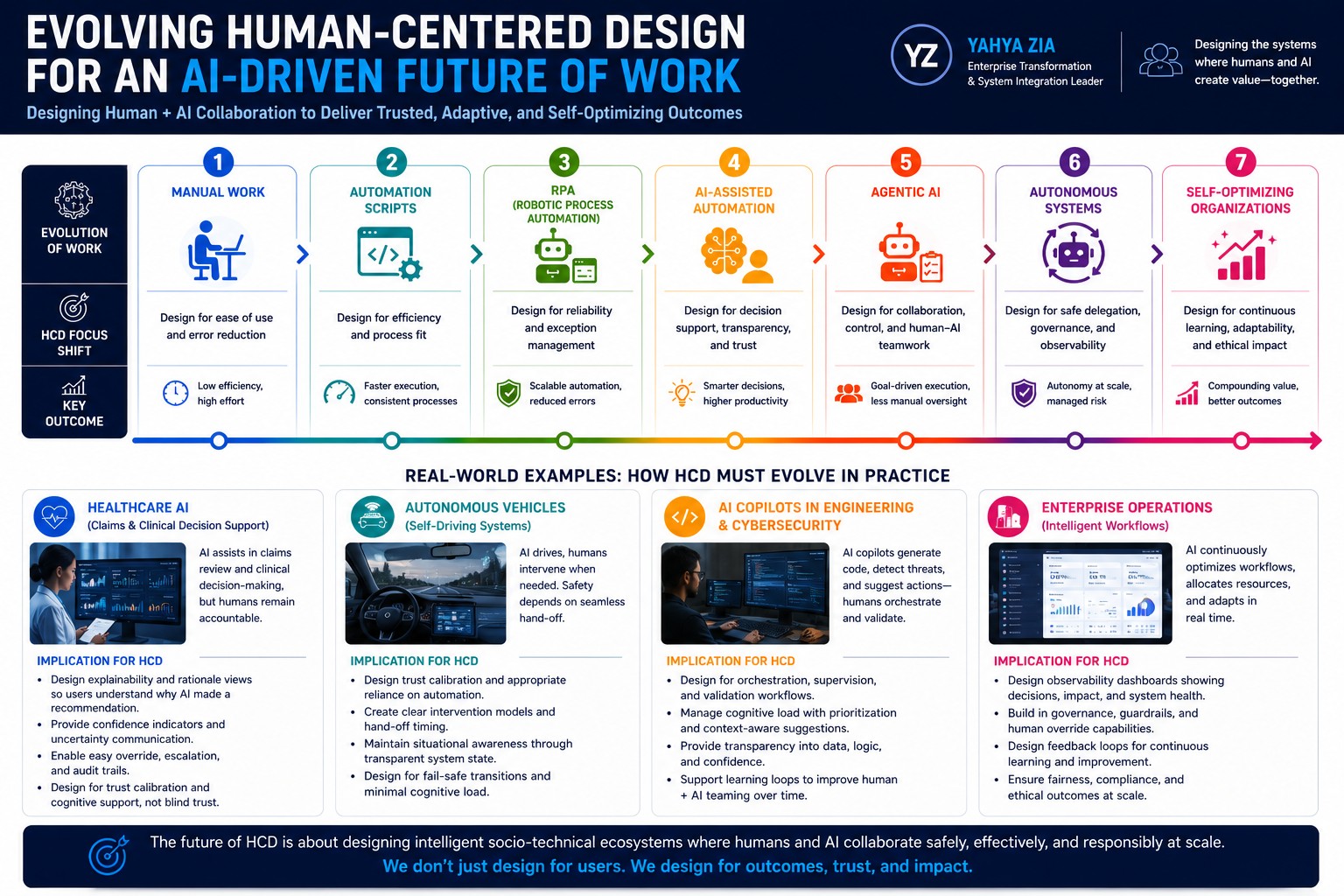
Human-Centered Design has always been strongest when it forces organizations to slow down and ask a simple question: what does this mean for the people who have to use, trust, operate, or live with the system?
That question still matters. But the environment around it is changing quickly.
As organizations move from manual operations and traditional automation toward agentic AI, autonomous systems, and self-optimizing enterprises, HCD cannot remain focused only on screens, workflows, and usability. The discipline has to expand with the systems it is helping shape.
Why the old frame is no longer enough
Traditional HCD was often applied at the point where humans directly interacted with a product, service, or system. Designers studied user needs, mapped journeys, simplified interfaces, reduced friction, and improved adoption.
That work is still necessary. But it is no longer sufficient.
AI-enabled systems increasingly make recommendations, initiate actions, coordinate workflows, adapt to patterns, and operate across organizational boundaries. In that environment, the human experience is not limited to the interface. It includes the ability to understand why a system behaved a certain way, when to trust it, when to intervene, and how to hold it accountable.
The design problem is moving upstream
When systems become more autonomous, design moves beyond usability. It becomes a question of role clarity, decision rights, confidence, transparency, escalation, governance, and mission impact.
Healthcare AI, for example, cannot be evaluated only by whether the dashboard is clean. It must also explain how a recommendation was formed, what evidence supports it, what uncertainty remains, and where human judgment is required.
Autonomous vehicles cannot be designed only for a smooth ride. They must support trust calibration, situational awareness, intervention timing, and a clear understanding of where responsibility shifts between human and machine.
AI copilots in engineering and cybersecurity cannot simply generate outputs faster. They have to support orchestration, prioritization, validation, and cognitive load management so humans remain in control of quality, risk, and judgment.
Enterprise operations cannot rely on intelligent workflows without observability, governance, human override, and feedback loops that make adaptation safe.
What HCD must start designing for
The next generation of Human-Centered Design has to account for intelligent socio-technical ecosystems: systems where people, AI agents, business rules, operating models, data, and governance mechanisms continuously interact.
That means designing for:
Explainability
People need to understand the rationale, assumptions, and evidence behind AI-supported recommendations and decisions.
Trust Calibration
Users need enough confidence to rely on intelligent systems without becoming over-dependent or blind to risk.
Orchestration
As AI copilots and agents multiply, humans need clear ways to coordinate work, validate outputs, and manage attention.
Governance
Adaptive systems require observability, guardrails, escalation paths, auditability, and human override capabilities.
From use to supervision
The deeper shift is this: organizations are moving from designing tools people use to designing systems humans supervise, collaborate with, and continuously govern.
That shift changes the meaning of human-centered. It is no longer only about whether a user can complete a task efficiently. It is also about whether the organization can maintain trust, accountability, adaptability, resilience, and alignment with intended outcomes as systems become more intelligent.
In the AI era, a poor human experience may not look like a confusing screen. It may look like an unexplained recommendation, an automation no one knows how to challenge, a workflow that optimizes locally but harms the broader mission, or an AI system that improves efficiency while eroding human accountability.
So, will Agentic AI break HCD?
Not if HCD evolves.
Agentic AI will break a narrow version of HCD that is limited to interface design, usability testing, and journey mapping after the major system decisions have already been made.
But it can strengthen a broader version of HCD: one that helps organizations design for human judgment, safe delegation, transparent reasoning, accountable autonomy, and mission-centered outcomes from the start.
The organizations that succeed will not simply automate workflows. They will intentionally design the human and AI relationship itself.