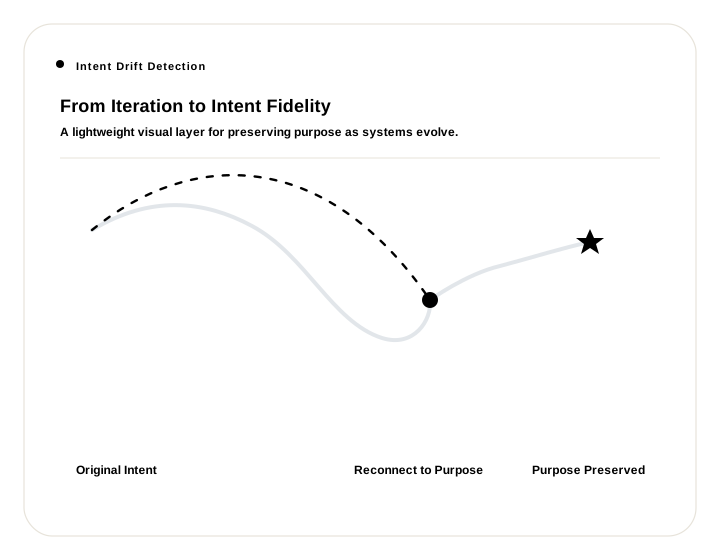
Every handoff, iteration, and optimization cycle introduces interpretation. Requirements evolve. Code evolves. Designs evolve. But the original why gets buried.
Intent Driven Design treats intent as a living artifact — something that must be captured, carried forward, and continuously validated as systems change.
The problem isn't Agile. It isn't AI. It's every iterative system.
IDD started with a simple observation: every time information passes from one person, team, artifact, or iteration to another, some of the original intent is lost.
In SAFe, this happens at every layer — from Executive Vision down through Portfolio, Epic, Feature, Story, Code, and Release. At each handoff, people interpret intent differently, teams optimize for local objectives, and artifacts become progressively detached from the original purpose.
By the time a solution reaches production, the organization may have delivered exactly what was requested in the backlog — while failing to deliver what was originally intended.
SAFe was simply the first environment where this was observed. The same pattern exists in AI-assisted development, enterprise transformation, product development, and agentic systems. The root cause is not the framework. The root cause is iterative drift.
IDD's answer: treat intent as a first-class artifact — not something buried in a kickoff deck, but something explicitly named, carried forward, and continuously validated throughout the lifecycle.
Four constructs. One goal: keep intent alive.
IDD is built on four distinct constructs — a principle, a mechanism, a measure, and a practice. Together they form a lightweight intent-preservation layer that sits on top of whatever delivery framework an organization already uses.
Intent as a first-class artifact
Original intent must be captured, named, and carried forward — not left in a kickoff meeting or business case. It is a living artifact, not a historical document.
Clarity Points
Deliberate moments throughout the lifecycle where teams resurface the original intent and ask: does what we're building still reflect why we started?
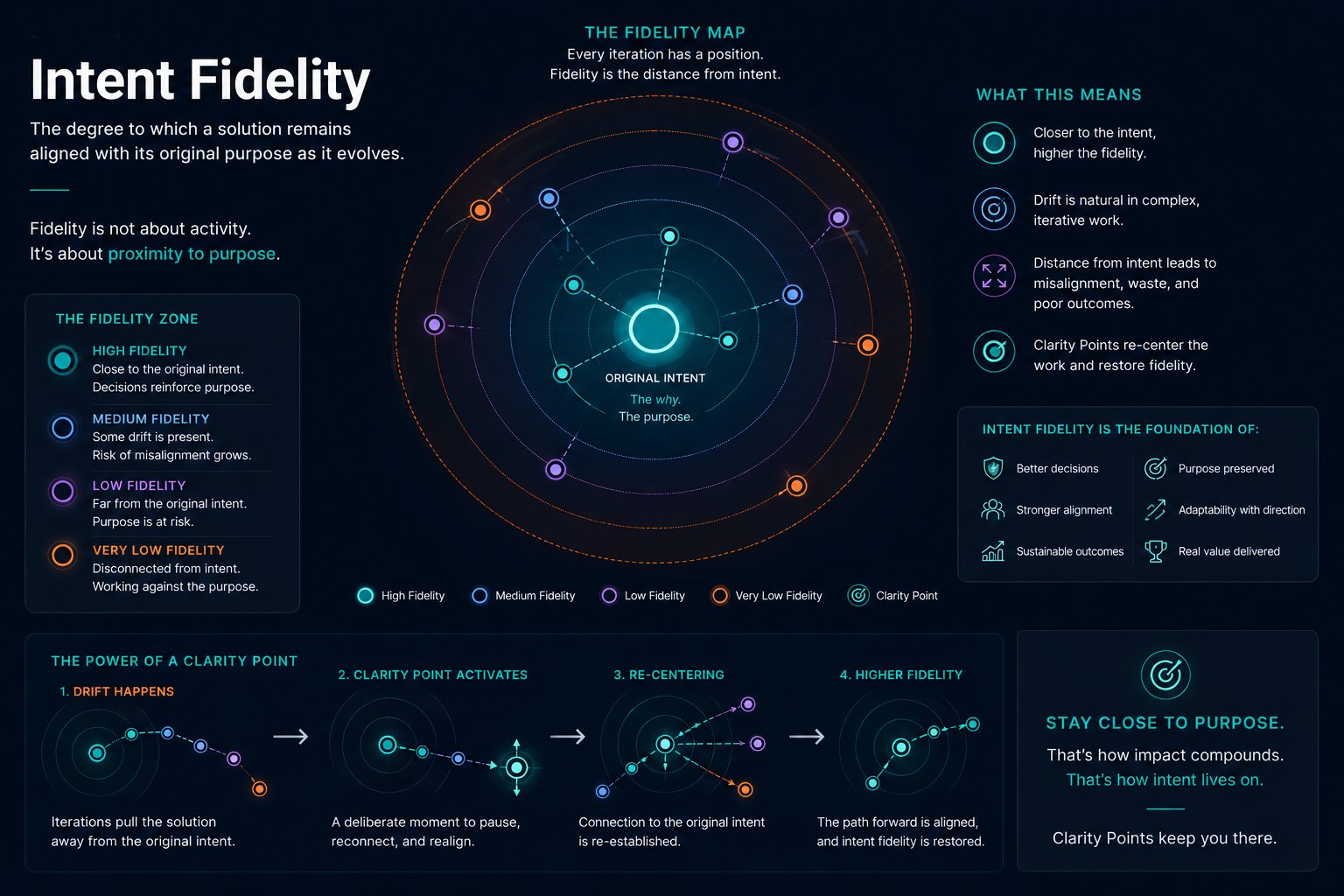
Intent Fidelity
Intent Fidelity is the degree to which a solution remains aligned with its intended purpose as it evolves. It is measurable, trackable, and independent of velocity or quality metrics.
Lean Assessments
Lightweight alignment checks — not reviews or approvals — that evaluate whether execution has drifted from the original operational or business objective.
Every iteration has a position. Fidelity is the distance from intent.
Fidelity is not about activity. It's about proximity to purpose. The closer your solution stays to the original intent, the higher the fidelity — and the more likely you are to deliver real value.
One core idea. Two proven applications.
IDD emerged from SAFe enterprise delivery. AI-assisted development brought it home — because AI amplifies the same drift pattern at an order of magnitude greater speed.
SAFe & Agile Delivery
Large-scale programs create many abstraction layers. Each layer introduces interpretation. IDD reconnects every work product back to the originating mission intent.
AI-Assisted Development
AI accelerates iteration to the point where intent degradation can occur within hours. IDD operates as an intent-preservation layer across prompts, generated code, refactoring, and agent decisions.
Not checkpoints. Not reviews. Intent resurface moments.
Clarity Points are not compliance gates. They are deliberate pauses where teams ask the questions that delivery frameworks never ask.
What was the original intent?
Not the current ticket. Not the sprint goal. The original reason this work was initiated — what problem it was created to solve.
What has changed?
Assumptions made at the start are rarely revisited. A Clarity Point forces teams to surface what has shifted since intent was first defined.
Are we still building the right thing?
Technically correct, on-time, on-budget — but are we still building the right thing? This is the question most delivery frameworks never ask.
Are we optimizing away from purpose?
Performance, cost, and efficiency improvements can silently shift a solution away from its founding purpose. Optimization is productive drift.
Intent Driven Design has its own home — with the complete methodology, patterns, and tools for preserving intent across iterative systems.
Visit IntentDrivenDesigns.com ↗